


Esports News DualMedia: How the World’s Most Competitive Gaming Coverage Is Reshaping Digital Sports Journalism
Esports News DualMedia: Competitive gaming has exploded into a global cultural force worth billions of dollars, and with it, the demand for fast, accurate, and deeply informed coverage has never been higher. Esports news DualMedia has emerged as one of the most talked-about names in this space — a platform that bridges the gap between raw gaming culture and the polished editorial standards audiences expect from mainstream sports journalism. Whether you follow League of Legends, Valorant, Counter-Strike, or the broader world of competitive gaming, DualMedia is increasingly the place where the community turns for breaking stories, tournament breakdowns, and player analysis.
This article takes a deep, comprehensive look at what esports news DualMedia actually is, how it operates, why it matters, and where it fits in the larger landscape of competitive gaming media. We’ll cover the platforms, the editorial philosophy, the business model, the community impact, and the future of this rapidly evolving media brand. If you care about esports journalism — whether as a fan, a content creator, or an industry professional — this is the guide you need.
What Is Esports News DualMedia and Why Does It Matter
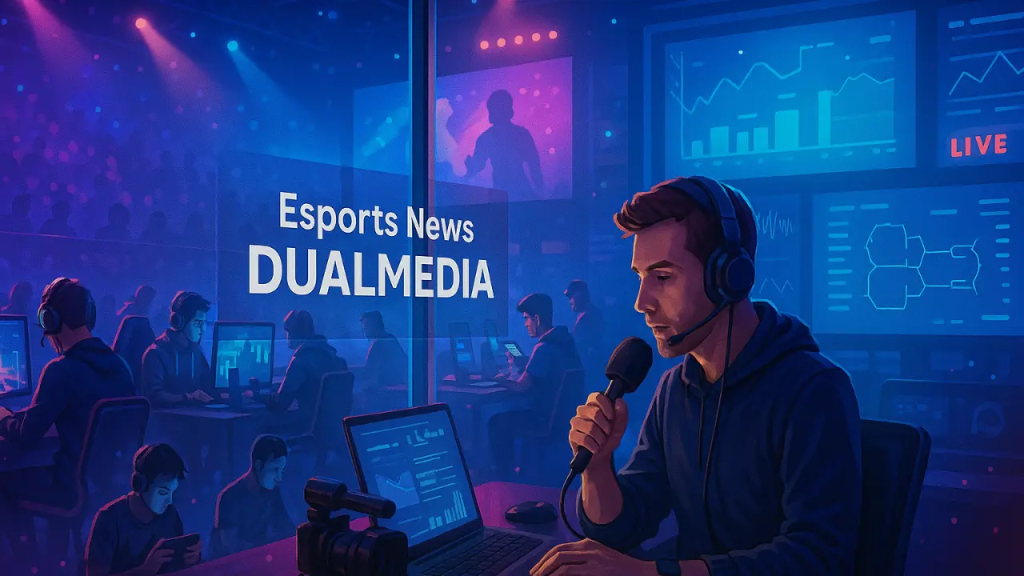
Esports news DualMedia refers to a media operation that covers competitive gaming across multiple channels and content formats simultaneously — creating a unified editorial identity while distributing content through platforms ranging from web articles and YouTube to Discord communities and live social streams. The “dual” in the name speaks to its foundational strategy: straddling both the traditional journalism model (editorial rigor, sourced reporting, fact-checking) and the creator-driven model (personality-forward coverage, community engagement, rapid-fire social content). This hybrid approach is what separates it from single-channel gaming blogs or YouTube-only content houses.

What makes DualMedia particularly interesting is the moment it arrived in. Esports journalism has long struggled with a credibility gap — too many outlets were either corporate-controlled PR machines for game publishers or unmoderated fan wikis with no editorial oversight. Esports news DualMedia stepped into that vacuum with a clear value proposition: independent, fan-first reporting with the speed of social media and the depth of traditional sports coverage. That positioning has resonated strongly with a generation of viewers who can instantly spot inauthenticity and who demand nuance alongside their news feeds.
The Dual-Platform Strategy That Defines DualMedia’s Coverage
At the heart of esports news DualMedia’s approach is a deliberate two-track publishing strategy that many larger sports networks have tried and failed to master. On one track, long-form editorial content — investigative pieces, player profiles, team financial deep dives, transfer window analysis — gets published with the pacing and sourcing standards you’d expect from a dedicated sports desk. On the other track, rapid-response content — live score updates, roster reveals, tournament bracket breakdowns — flows across social channels within minutes of events happening. These two tracks don’t compete; they complement each other, driving audiences from one to the other in a virtuous loop.
This dual-publishing model is especially powerful in esports because the audience is almost entirely digital-native. Readers aren’t flipping between a print newspaper and a TV broadcast; they’re toggling between a browser tab, a Discord server, a YouTube stream, and a Twitter feed simultaneously. By being present and excellent on multiple fronts at once, esports news DualMedia meets its audience exactly where they are rather than expecting the audience to travel to a single destination. The result is dramatically higher engagement rates than single-platform competitors and a much stickier relationship with the core community.
The Esports Media Landscape DualMedia Is Disrupting
To understand why esports news DualMedia has made waves, you need to understand what the competitive gaming media landscape looked like before outlets like it began gaining traction. For much of esports’ history, game-specific coverage was siloed — a League of Legends outlet rarely covered CS:GO, and a Dota publication had little reason to publish Rocket League content. This fragmentation made it extremely difficult for audiences to develop a single trusted source for comprehensive esports news, the way a sports fan might rely on ESPN or Sky Sports for cross-discipline coverage.
DualMedia’s cross-title editorial strategy directly challenges this fragmentation. By treating esports as a single industry with interconnected stories — shared sponsors, overlapping player bases, common business structures — rather than a collection of separate game-specific communities, the outlet has created a category of esports journalism that didn’t previously exist at scale. This approach also opens business opportunities: advertisers and sponsors who want to reach “esports fans” broadly, rather than just “Valorant fans” or “Call of Duty fans,” have a natural home on a platform that aggregates across titles.
How DualMedia Builds Credibility in a Trust-Starved Industry
Credibility is perhaps the hardest thing to build in esports media — and the easiest thing to lose. The community has an excellent memory for outlets that ran unverified rumors, published pay-to-play sponsored content without disclosure, or got cozy with team organizations in ways that compromised editorial independence. Esports news DualMedia has worked deliberately to avoid these pitfalls through a combination of transparent sourcing practices, clear sponsored content labeling, and a willingness to publish stories that powerful organizations in the industry would prefer remain quiet.
One of the more telling credibility signals DualMedia has established is its track record on transfer reporting. In a scene where roster moves can shift entire competitive landscapes, being early and accurate on player movement stories is the journalism equivalent of breaking a trade deadline deal in traditional sports. Sources within team organizations, player agents, and tournament operators have reportedly grown comfortable feeding information to DualMedia journalists because those journalists have demonstrated they protect sources and verify before publishing — a combination that is, frankly, rarer in esports media than it should be.
The Editorial Team and Talent That Powers DualMedia’s Reporting
Behind every strong media brand is a strong team, and esports news DualMedia has made thoughtful talent investment a visible part of its editorial identity. Rather than relying exclusively on generalist gaming journalists who treat esports as a side beat, the outlet has recruited writers and analysts who have deep game-specific expertise — people who played the titles they cover at high level, who have relationships inside competitive scenes, and who can translate complex strategic developments for general audiences without dumbing them down. This expertise-first hiring philosophy shows clearly in the quality of the coverage.
The editorial culture at DualMedia also appears to prize speed-without-recklessness, a balance that many newsrooms claim but few actually achieve. The team operates with rapid verification workflows that allow them to push breaking news faster than most traditional sports outlets while maintaining enough editorial oversight to avoid the costly corrections that have plagued competitor brands. That reputation for getting it right the first time compounds over time, building audience trust that translates directly into return visits, newsletter subscriptions, and social follows — the metrics that determine long-term media viability.
DualMedia’s Coverage of Major Esports Tournaments and Events
Tournament coverage is where esports news DualMedia’s multi-platform strategy truly shows its value. Major events like the League of Legends World Championship, IEM Katowice, The International, or Valorant Champions are weeks-long media opportunities that demand pre-event analysis, live reporting, post-match breakdowns, and long-tail retrospective content. Most outlets do one or two of these well; DualMedia has built systems to do all of them at a high level simultaneously, which gives their tournament coverage a completeness that rivals find difficult to match.
What distinguishes the tournament coverage particularly is the integration of statistical analysis with narrative storytelling. Rather than simply reporting match results, DualMedia journalists contextualize outcomes within broader competitive storylines — how a team’s performance reflects months of roster changes, how a player’s individual statistics tell a larger story about role evolution in the meta, how a bracket result might reshape the sponsorship landscape heading into the next season. This layered approach turns what could be straightforward game recaps into genuinely compelling sports journalism that serves both the casual fan and the hardcore competitive analyst.
Understanding DualMedia’s Business Model and Revenue Streams
The economics of esports media are notoriously difficult, and esports news DualMedia has had to be inventive in building a sustainable business around its journalism. Advertising revenue from direct brand partnerships — particularly with endemic sponsors like peripheral manufacturers, energy drink companies, and gaming chair brands — forms one revenue pillar. But the outlet has also developed subscription offerings, event ticketing partnerships, branded content studios, and merchandise lines that reduce dependence on any single revenue source.
One of the more forward-thinking aspects of DualMedia’s business model is its community monetization approach. Rather than treating the audience purely as an advertising vehicle, the outlet has built revenue streams that reward community participation — membership tiers that offer early access to content, exclusive Discord channels with editorial staff, and direct support mechanisms through platforms like Patreon. This community-forward monetization aligns financial incentives with audience satisfaction in a way that traditional ad-supported media simply cannot, and it builds the kind of loyal subscriber base that provides stable revenue even when advertising markets fluctuate.
Comparing Esports News DualMedia to Competitor Outlets
The esports media space is competitive, and understanding how DualMedia stacks up against its peers helps clarify what makes it distinctive. The table below offers a structured comparison of DualMedia against several notable competitor outlets across key editorial and business dimensions.
| Dimension | DualMedia | Traditional Esports Blog | YouTube-Only Creator | Publisher-Owned Media |
|---|---|---|---|---|
| Cross-title coverage | Broad, multi-game | Usually single-title focused | Varies by creator niche | Narrow (tied to publisher’s titles) |
| Editorial independence | High — no publisher affiliation | Medium — often dependent on access | Low to medium | Very low |
| Breaking news speed | Very fast with verification | Fast but variable accuracy | Moderate | Slow (corporate approval cycles) |
| Long-form depth | Strong | Varies widely | Rare | Occasional sponsored features |
| Community engagement | Integrated into editorial model | Post-publication comments only | High via YouTube comments | Minimal |
| Revenue model | Diversified (ads, subs, branded content) | Ad-dependent | Ad + sponsorship | Corporate subsidy |
| Platform presence | Multi-platform strategy | Web-primary | YouTube-primary | Web + owned app |
| Analytical depth | High — statistics + narrative | Medium | Low to medium | Low |
| Source transparency | Clearly labeled | Variable | Often absent | Absent or PR-driven |
This comparison makes clear that DualMedia occupies a specific and relatively underserved position in the market — one that combines the editorial independence of a pure-play journalism operation with the engagement infrastructure of a community media brand.
The Role of Social Media in DualMedia’s Content Distribution
Social media isn’t a secondary channel for esports news DualMedia — it’s a primary publishing surface that shapes editorial decisions from the first draft. The team operates with an understanding that a well-timed tweet can drive as much traffic to a long-form investigation as weeks of SEO work, and that community conversations on platforms like Reddit and Discord can surface story ideas that no editorial planning meeting would generate. This social-first mentality means the outlet treats every piece of content as a conversation starter rather than a finished product, building distribution into the creative process itself.
The specific social strategy DualMedia employs is worth examining because it differs from what most media companies attempt. Rather than simply repurposing content across channels — posting the same headline across Twitter, Instagram, and Facebook — the team creates channel-native content that fits the specific language and expectations of each platform. A tournament result gets a quick-read Twitter thread with key stats, a YouTube Short with dramatic match highlight clips, and a Discord discussion prompt that pulls in community perspectives — all driving back to the same definitive match report on the main site. This multi-format approach multiplies the reach of every editorial investment.
How DualMedia Covers Player Stories and Human Interest Content
Competitive gaming has long suffered from coverage that treats players primarily as performance statistics rather than human beings with complex stories, pressures, and motivations. Esports news DualMedia has made player-centric storytelling a visible editorial priority, commissioning and publishing long-form profiles that go beyond match records to examine the human dimensions of professional gaming life — the sacrifices, the mental health challenges, the financial pressures, the cultural backgrounds that shape how players compete and communicate.
This investment in human interest coverage serves both editorial and business purposes. Editorially, it elevates the quality of the journalism and contributes to a broader cultural argument for esports as a legitimate and compelling sport deserving of the same narrative treatment as football or basketball. From a business perspective, player profile content tends to have long search shelf-life, generates strong social sharing among fan communities, and attracts readers who might not otherwise engage with pure match coverage. The combination creates exactly the kind of sticky, high-value content that builds media brands that last.
DualMedia’s Approach to Investigative Esports Journalism
Perhaps the most important thing a media outlet can do to establish genuine authority is publish investigative reporting that holds powerful parties accountable — and esports news DualMedia has shown a willingness to do exactly that in a scene where access-dependent journalists often avoid controversy. Coverage of player contract disputes, organization financial irregularities, tournament operator conflicts of interest, and discriminatory practices inside team environments has appeared under the DualMedia banner in ways that have genuinely moved conversations and, in some cases, resulted in industry changes.
As veteran games journalist Rod Breslau has noted about the broader esports media landscape: “The scene needs more journalists who are willing to be unpopular with the organizations they cover. Accountability journalism is what separates media from marketing.” DualMedia appears to have internalized this philosophy, and the outlets that have taken controversial stands on industry accountability have typically ended up with stronger audience loyalty over time — readers and viewers reward editorial bravery, particularly in communities where trust in institutions is already fragile.
The Audience Demographics and Community Culture of DualMedia
Understanding who reads and watches esports news DualMedia matters enormously for understanding why its editorial and business choices make sense. The core audience skews young — predominantly 18 to 34 — digitally fluent, highly engaged with gaming culture more broadly, and deeply skeptical of corporate media. These are consumers who have grown up with algorithmic content feeds, who can instantly detect inauthenticity, and who have strong in-group cultural codes around how gaming content “should” feel and sound. Getting the tone wrong — too corporate, too mainstream, too disconnected from actual competitive gaming culture — is immediately punished with disengagement.
DualMedia has navigated this audience’s expectations by hiring journalists and content creators who are genuinely embedded in gaming culture, not parachuted in from mainstream sports media. The outlet’s voice — across articles, social posts, and video content — consistently reflects a genuine love of competitive gaming that audiences recognize and respond to. This cultural authenticity doesn’t mean the coverage is soft or uncritical; rather, it means the critique comes from inside the tent, from people who care about the scene’s health and want it to be better, which is a fundamentally different posture than external observers reporting on a curiosity.
SEO Strategy and Search Visibility in Esports Coverage
Any serious discussion of how esports news DualMedia operates has to include its search strategy, because search engine visibility is how digital media brands grow their audiences beyond their existing community. The outlet has clearly invested in understanding how its target audience searches for esports content — not just obvious queries like team names and tournament results, but the long-tail informational queries that indicate genuine interest in understanding competitive gaming more deeply. This includes queries around game meta analysis, player transfer rumors, tournament format explanations, and historical competitive context.

The technical SEO execution at DualMedia reflects a sophisticated understanding of how Google evaluates content authority in niche verticals. Rather than publishing thin content on every trending keyword, the outlet builds comprehensive topic clusters — a pillar page on a major tournament supplemented by deep-dive articles on individual teams, players, and strategic storylines — that signal topical authority to search algorithms while also genuinely serving readers better than competitors who publish isolated, unlinked coverage. This architecture builds compounding search value over time, making early content investments more valuable as the site’s overall authority grows.
DualMedia’s Video Content Strategy and YouTube Presence
Video is not optional in esports media — it’s the native language of the audience and the content format that best captures the visual spectacle of competitive gaming. Esports news DualMedia has developed a video content philosophy that differs from the dominant YouTube esports content formula, which tends toward reaction videos, tier list debates, and highly produced documentary-style content that requires significant production budgets. DualMedia’s video approach is more journalism-adjacent: interview-driven player profiles, tournament analysis with actual game footage, and news explainers that translate complex competitive developments for broader audiences.
The YouTube presence also serves an important discovery function in DualMedia’s overall audience acquisition strategy. While existing fans might find the outlet through direct navigation or social follows, YouTube’s recommendation algorithm surfaces esports content to viewers who don’t yet know DualMedia but are clearly interested in the category. A well-produced video about a major roster shakeup or a championship performance can introduce thousands of new viewers to the brand, who then convert into newsletter subscribers, site visitors, and social followers — expanding the audience funnel through one of the few remaining platforms where organic discovery at scale is still possible.
The Future of Esports Journalism and DualMedia’s Position
The future of esports media is likely to be defined by several converging trends that esports news DualMedia appears to be positioning itself to navigate well. First, the continued globalization of competitive gaming — with major scenes now established in South Korea, China, Brazil, Europe, Southeast Asia, and North America — creates both opportunities and challenges for media brands. The opportunity is vast: a truly global esports media brand would command an audience comparable to major traditional sports networks. The challenge is that regional scenes have distinct cultures, languages, and story angles that require genuine local expertise rather than US or Europe-centric coverage translated for global consumption.
Second, the evolution of how esports content is distributed — with traditional video platforms facing competition from in-game watching experiences, streaming platform integrations, and emerging social video formats — will require ongoing adaptation. DualMedia’s multi-platform DNA gives it more flexibility than competitors locked into single-channel strategies, but the pace of platform change in digital media is genuinely relentless and there is no permanent safe position. The outlets that will thrive in the next decade of esports journalism are those that stay genuinely curious about new distribution technologies rather than defending incumbent formats — and on this dimension, DualMedia’s track record suggests reason for optimism.
Why Esports Fans Trust DualMedia Over Mainstream Sports Media
It’s worth spending a moment on a question that many people outside the esports community struggle to understand: why don’t competitive gaming fans simply turn to mainstream sports media for their coverage? ESPN, Sky Sports, and other major outlets have made significant investments in esports coverage over the past decade — why hasn’t that investment translated into audience dominance? The answer comes down to authenticity, expertise, and structural incentives that mainstream sports media fundamentally cannot overcome.
Mainstream sports outlets cover esports with the same frameworks they apply to traditional sports — heavy on “human interest” angles aimed at non-fans, light on the game-specific strategic analysis that actually interests the core audience, and perpetually treating competitive gaming as a novelty rather than a mature industry. Esports news DualMedia, by contrast, was built by people who understand that the core audience already knows what esports is, doesn’t need to be convinced it’s real or legitimate, and wants coverage that assumes that baseline of knowledge and builds from there. That difference in audience assumptions shapes everything from headline writing to analytical depth, and it’s a gap that no amount of investment can close if the fundamental editorial posture is wrong.
Building a Global Esports Brand Through Local Scene Coverage
One of the more sophisticated elements of DualMedia’s editorial strategy is how it balances global esports narratives with local scene coverage. The biggest esports stories — major tournament results, superstar player movements, game developer decisions — have inherently global relevance and drive the highest traffic numbers. But the most engaged, loyal audience members are often those who follow specific regional scenes closely, and building that deep loyalty requires coverage that goes beyond the headline-generating global events to cover regional leagues, emerging players, local tournament ecosystems, and the cultural specifics of how competitive gaming looks and feels in different parts of the world.
DualMedia has begun building out regional coverage capabilities in ways that directly serve this strategy. Rather than parachuting a single journalist into a regional market for a one-off tournament coverage piece, the outlet has worked to develop correspondent relationships and regional staff who can provide consistent, context-rich coverage of scenes outside the traditional North American and European reporting centers. This investment is both editorially right — it produces better journalism — and strategically smart, as it creates audience relationships in fast-growing esports markets in Southeast Asia, Latin America, and the Middle East before competitors with larger resources get serious about those regions.
DualMedia’s Influence on Esports Industry Narratives
Beyond simply reporting on the esports industry, esports news DualMedia has — through the accumulation of its coverage — begun to meaningfully shape how the industry understands itself. When a media outlet consistently covers certain story angles, maintains consistent standards for what counts as newsworthy, and builds a reputation for accuracy and depth, it effectively sets agenda for the broader discourse. Organizations, players, and tournament operators know that how DualMedia covers a story will influence how the community discusses it, which gives the outlet genuine leverage in its relationships with industry stakeholders.
This influence isn’t always comfortable — for DualMedia or for the industry it covers. When investigative coverage surfaces uncomfortable truths about how organizations treat players, or how tournament operators manage prize pool finances, or how game publishers exercise editorial pressure over independent media, there are inevitably tensions. But maintaining that independence — the willingness to publish stories that powerful parties would prefer remain hidden — is precisely what gives esports news DualMedia the credibility that makes its positive coverage meaningful and its critical coverage impactful. A media outlet that only publishes what the industry wants it to publish isn’t a media outlet; it’s a PR department.
Conclusion
Esports news DualMedia represents something genuinely valuable in the landscape of competitive gaming media: a principled, multi-platform journalism operation that takes its editorial responsibilities seriously while remaining deeply connected to the community it serves. In an industry where the line between journalism, marketing, and fan content is routinely blurred, DualMedia’s commitment to editorial independence, sourced reporting, and community-first distribution makes it a model worth studying — not just for esports media professionals, but for anyone trying to understand how digital journalism can succeed in an age of fragmented attention and institutional distrust.
The dual approach — rigorous long-form journalism combined with fast, culturally authentic social content — addresses a real structural gap in how competitive gaming has historically been covered. And as esports continues its expansion into mainstream cultural consciousness, with prize pools in the tens of millions, stadium-filling live events, and franchise valuations in the hundreds of millions, the need for serious, independent journalism to cover the industry will only grow. Esports news DualMedia has positioned itself to meet that need, and if its track record over recent years is any indication, it has the talent, the systems, and the editorial philosophy to do it well.
FAQs
What exactly is esports news DualMedia?
Esports news DualMedia is a multi-platform competitive gaming media brand that combines traditional editorial journalism — sourced reporting, in-depth analysis, investigative coverage — with community-driven social content distributed across platforms including web, YouTube, and social media. Unlike single-channel gaming blogs or purely creator-driven channels, esports news DualMedia operates a two-track publishing strategy that serves both breaking news needs and long-form editorial depth simultaneously.
How does DualMedia differ from other esports news outlets?
What sets esports news DualMedia apart from competitors is its deliberate cross-title coverage, strong editorial independence from game publishers and team organizations, and its integrated community engagement model. Most esports outlets are either game-specific or organization-affiliated; DualMedia operates as a genuinely independent, industry-wide media brand, which gives it credibility and editorial freedom that access-dependent outlets cannot maintain.
Is DualMedia a reliable source for competitive gaming news?
Based on its reporting track record, esports news DualMedia has developed a reputation for sourced, verified reporting — particularly in the high-stakes arena of player transfer rumors and roster moves, where accuracy matters enormously to a community that follows competitive rosters closely. The outlet’s transparent sourcing practices and willingness to correct errors publicly are strong indicators of editorial reliability in a space where many competitors prioritize speed over accuracy.
How does DualMedia make money as an esports media company?
Esports news DualMedia has built a diversified revenue model that includes direct brand advertising partnerships with endemic gaming sponsors, subscription membership tiers for dedicated community members, branded content production for select brand partners, and community support through platforms like Patreon. This diversification reduces the financial vulnerability that has caused many single-revenue-stream esports outlets to collapse when advertising markets shifted.
Does DualMedia cover all major esports titles or just specific games?
One of esports news DualMedia’s defining editorial commitments is broad cross-title coverage. Rather than specializing in a single game or franchise, the outlet covers the esports industry comprehensively — including titles like League of Legends, Valorant, Counter-Strike, Dota 2, Rocket League, Call of Duty, and others. This breadth makes DualMedia valuable both to readers who follow multiple competitive titles and to advertisers seeking broad reach across the esports audience as a whole.
How can content creators and journalists get involved with DualMedia?
Esports news DualMedia has shown openness to contributing writers, regional correspondents, and video content collaborators who bring genuine expertise in specific competitive scenes or titles. The outlet’s expansion into regional coverage particularly creates opportunities for journalists embedded in scenes outside North America and Europe. The best approach is direct outreach through the outlet’s editorial contact channels, with specific story pitches that demonstrate both subject expertise and an understanding of DualMedia’s editorial standards and audience.